What Are Seller Concessions?
Seller concessions (also called seller credits) are costs that you as the home seller agree to pay on behalf of the buyer to help facilitate the sale. These are deducted from your net proceeds at closing rather than paid out of pocket upfront.
Common seller concessions include:
- Closing costs (appraisal fees, lender fees, escrow fees,... buyers have plenty of fees!)
- Credits in lieu of repairs discovered during home inspections • Prepaid property taxes and homeowners insurance
- Mortgage rate buydowns (temporarily reducing the buyer's interest rate)
While seller concessions have always existed, their frequency and size have increased dramatically in the current Dallas real estate market.
How Common Are Seller Concessions in Dallas-Fort Worth?
The data tells a clear story: seller concessions have become the norm, not the exception.
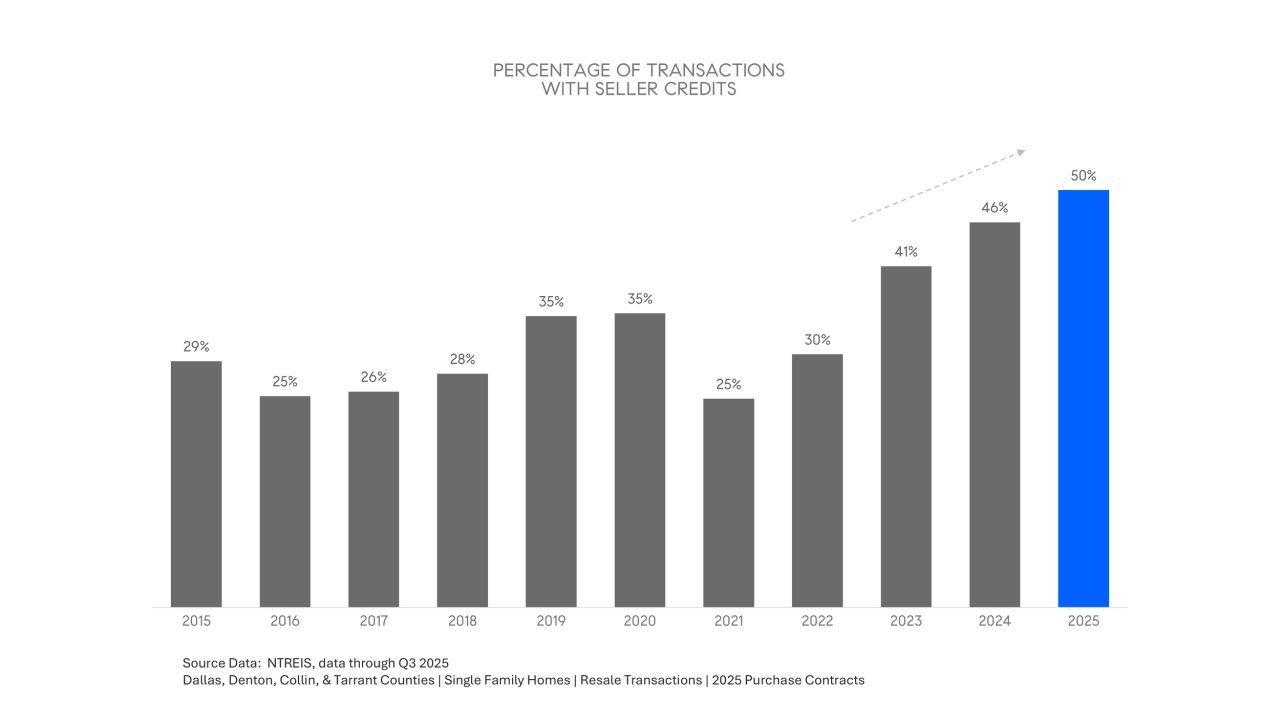
Based on analysis over 50,000 home sales this year in Dallas, Denton, Collin, and Tarrant County:
- 50% of all transactions now include seller concessions
- This is up from just 29% average between 2015-2022
- The increase has been particularly sharp in 2023-2025
This dramatic shift means seller concessions are no longer a special circumstance, they're something every Dallas seller must plan for.
The Trend Accelerated in 2025
Monthly data shows the trend intensifying throughout 2025.
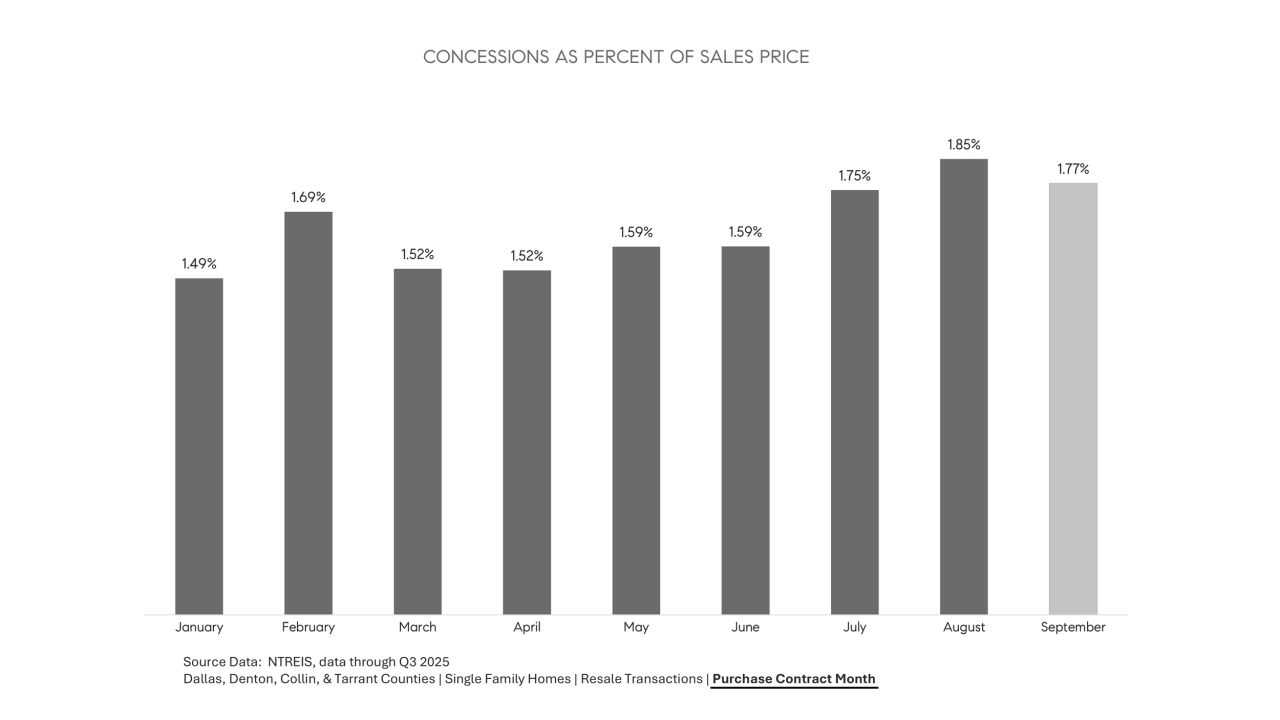
For current negotiations in Fall 2025, expect concessions in the 1.7-1.9% range.
How Much Should I Budget for Seller Concessions?
The median seller concession in Dallas-Fort Worth is $6,000, representing 1.8% of the sales price.
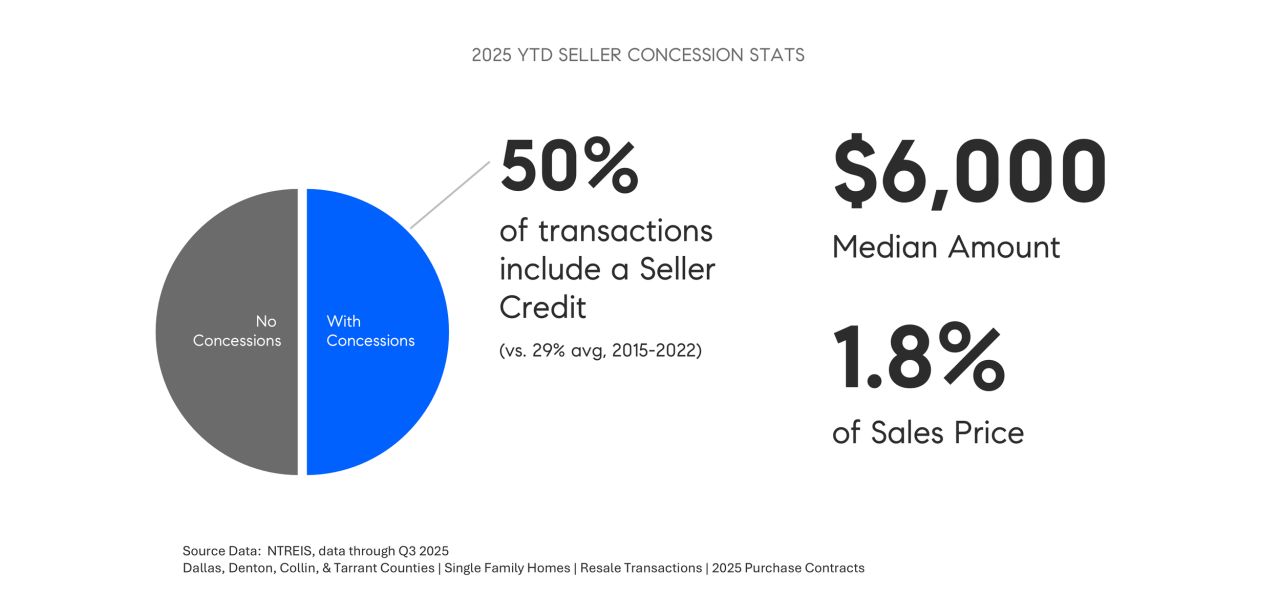
This $6,000 figure is critical for your net proceeds calculation. Many sellers are surprised at closing when their check is smaller than expected because they didn't factor in this "hidden" cost.
Pro Tip: When your agent prepares a seller net sheet, make sure they include a line item for seller concessions to give you a realistic bottom-line number.
Do Seller Concessions Vary by Home Price?
Absolutely. The frequency and percentage of seller concessions vary significantly across price tiers:
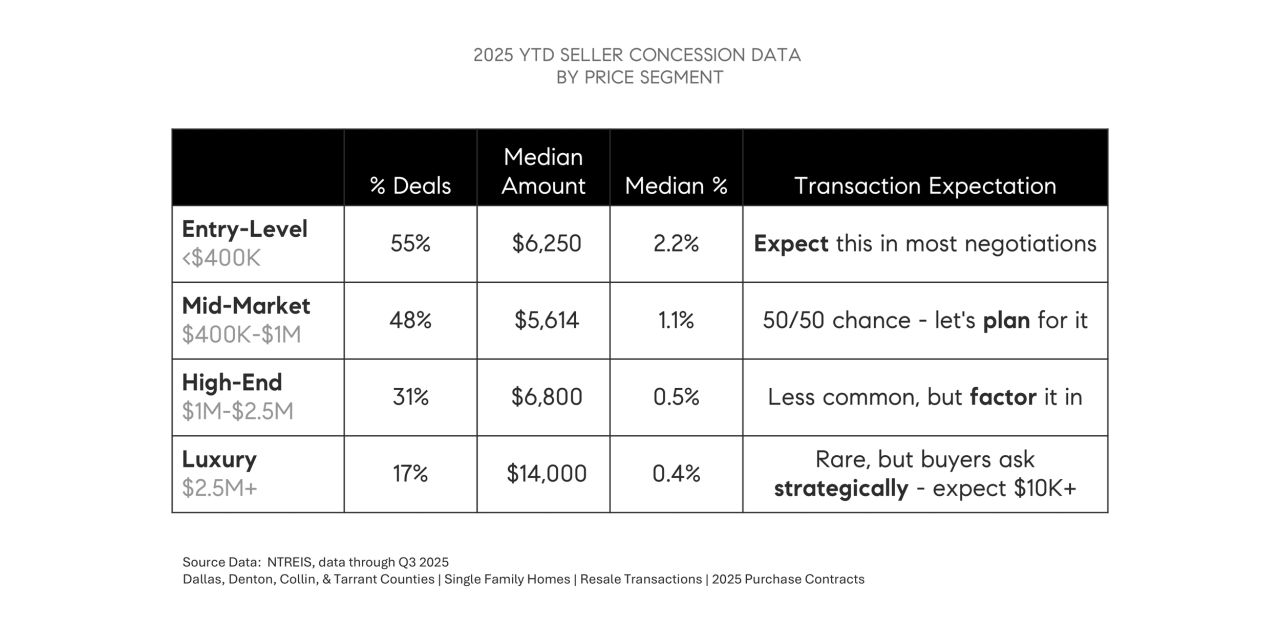
Entry-Level Homes (Under $400K)
- 55% of deals include concessions
- Median amount: $6,250
- Percentage: 2.2% of sales price
Mid-Market Homes ($400K-$1M)
- 48% of deals include concessions
- Median amount: $5,614
- Percentage: 1.1% of sales price
High-End Homes ($1M-$2.5M)
- 31% of deals include concessions
- Median amount: $6,800
- Percentage: 0.5% of sales price
Luxury Homes ($2.5M+)
- 17% of deals include concessions
- Median amount: $14,000
- Percentage: 0.4% of sales price
Key insight: Lower-priced homes face both higher frequency AND higher percentage impact. If you're selling an entry-level home, concessions are more likely than not.
How Do Days on Market Affect Seller Concessions?
Time is money - literally. The longer your home sits on the market, the more you'll likely pay in seller concessions:
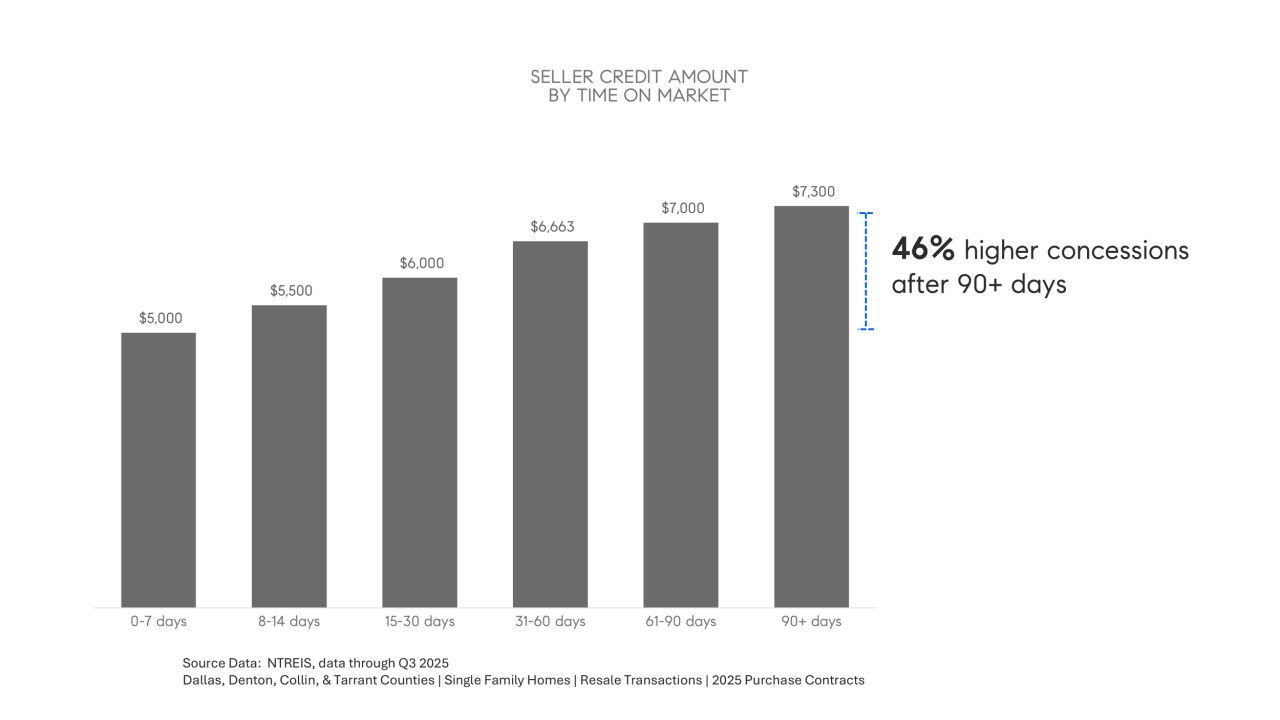
- 0-7 days: $5,000
- 8-14 days: $5,500
- 15-30 days: $6,000
- 31-60 days: $6,663
- 61-90 days: $7,000
- 90+ days: $7,300
That represents a 46% increase in concession amounts between homes that sell in the first week versus those that linger beyond 90 days.
Why This Matters
This data reinforces a fundamental principle: smart, aggressive pricing from day one saves you money. Not only do you avoid price reductions, but you also minimize the concessions you'll need to offer to close the deal.
A home that sits becomes stale. Buyers assume something is wrong, and they gain negotiating leverage, which often results in them asking for more help with closing costs or repairs.
How Do Price Reductions Affect Seller Concessions?
Sellers typically adjust their list price first, then face concession requests on top of those reductions.
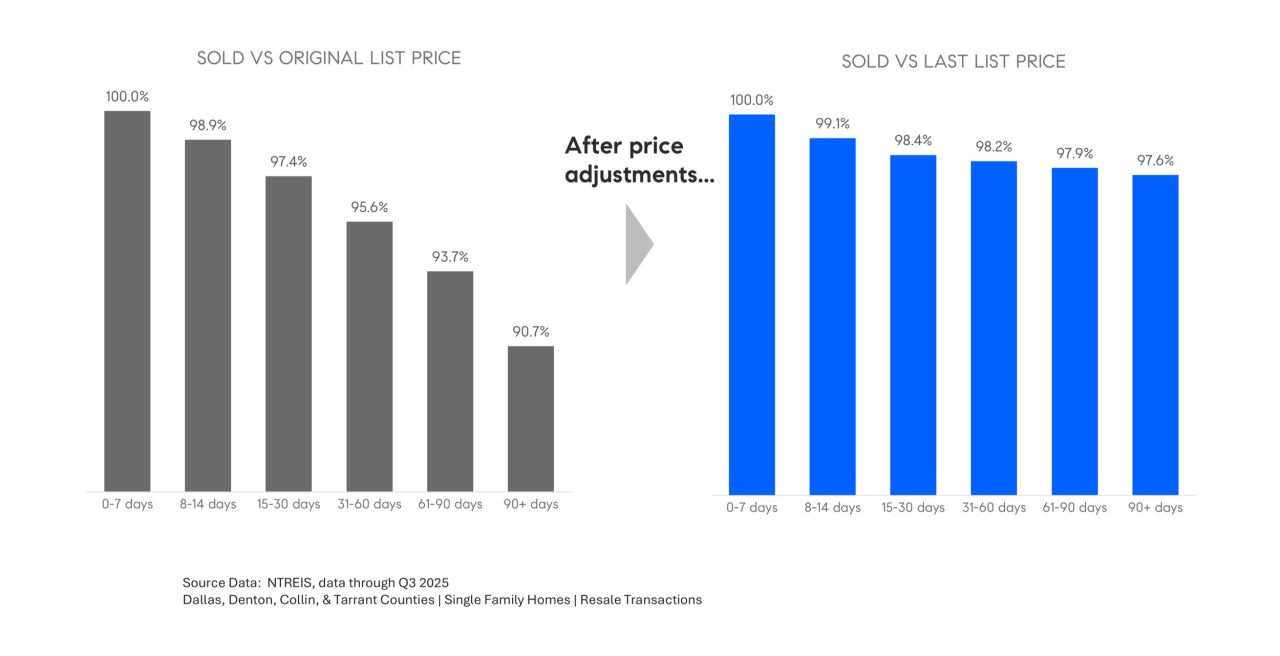
The data shows:
- First, sellers reduce price: Homes on market 90+ days sell for 90.7% of original list price
- Then, they stabilize: After price adjustments, homes sell for 97-99% of their adjusted price
- Finally, concessions are added: On top of the reduced price, sellers then offer concessions
This means the true cost of overpricing isn't just the price reduction—it's the price reduction PLUS the increased likelihood of a high concession request.
Do Buyers Who Ask for Concessions Pay More?
Here's the counterintuitive finding: Yes, buyers who request concessions typically pay 1-3% more for the home.
This means sellers often net similar or better amounts when offering concessions compared to deals without them.
Why Does This Happen? Buyers asking for concessions are essentially requesting help with their upfront costs. In exchange, they are often willing to pay a slightly higher purchase price to get into the home.
- Higher recorded sale price protects neighborhood values and future appraisals
- Net proceeds are often similar once you subtract the concession amount
- The sale closes faster because the buyer can afford to move forward
Example:
- Without concessions: $500,000 sale price → Net proceeds ~$490,000
- With concessions: $515,000 sale price - $6,000 concession → Net proceeds ~$499,000
The seller nets $9,000 MORE by offering the concession.
This is particularly true for homes with longer market times. At 90+ days, sellers offering concessions actually net more than those who don't.
How Do I Calculate Seller Concessions for My Home?
Use this calculator based on your home's price point and expected time on market:
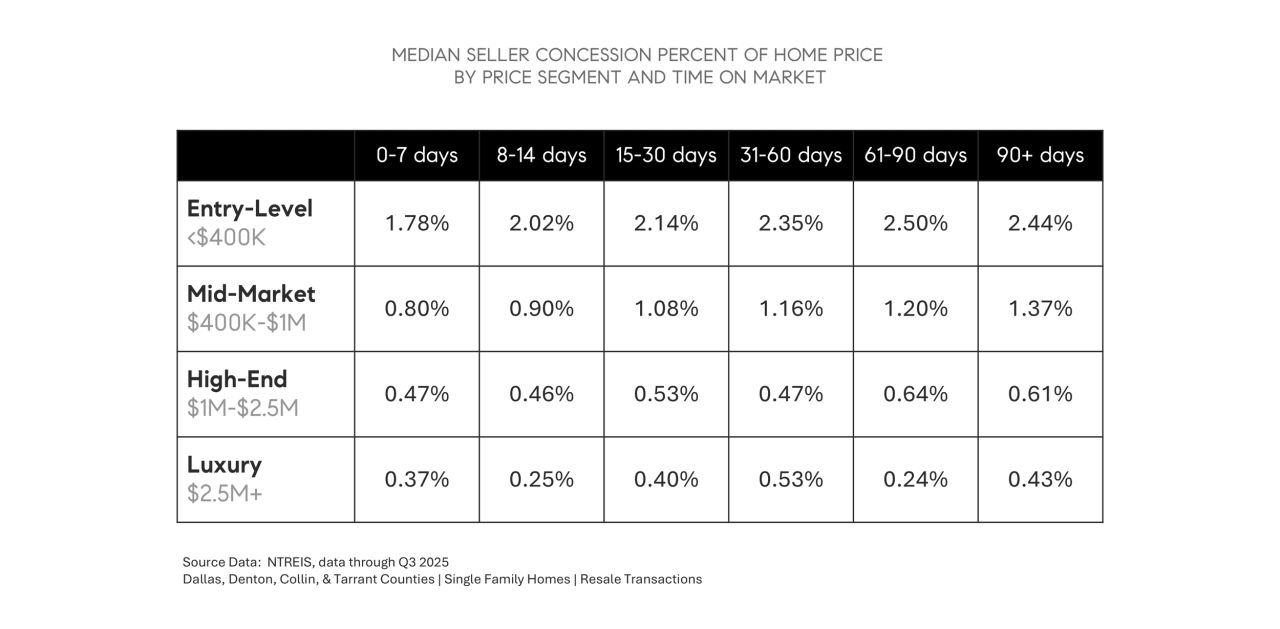
How to Use This Calculator
Step 1: Identify your price category Step 2: Estimate your expected days on market based on current comparable sales Step 3: Find the intersection point for your percentage Step 4: Multiply your expected sale price by that percentage
Example:
- $550,000 home (Mid-Market)
- Expected to sell in 35 days
- Look up: Mid-Market, 31-60 days = 1.16%
- Calculation: $550,000 × 1.16% = $6,380 expected concession
Are Seller Concessions Better Than Price Reductions?
In many cases, yes - especially for the overall health of your neighborhood's real estate market.
Why Concessions Often Beat Price Reductions
1. Higher recorded sale price
The sales price that gets recorded is the number the people focus on. Real estate agents use this data to establish comparable sales (comps) for future listings. A higher sale price, even with concessions, benefits your entire neighborhood.
2. Better appraisal support
When your neighbor lists their home next month, their appraisal will be based partly on your sale. A $500,000 sale price supports their value better than a $485,000 sale, even if you netted the same amount after concessions.
3. Faster sales velocity
Concessions help buyers overcome their biggest hurdle: upfront cash. By helping with closing costs, you remove a barrier to closing, which means your home sells faster.
4. Tax implications
While you should consult a tax professional, seller concessions are typically treated as sales expenses that may reduce your taxable gain, similar to other closing costs.
When Price Reductions Make More Sense
Price reductions are the better strategy when:
- Your home has been overpriced from the start
- Comparable sales don't support your current price
- You're competing against significantly lower-priced inventory
- Buyers aren't making offers at all (indicating a price problem, not a terms problem)
Strategy: Consider price reductions FIRST to generate showing activity, then use concessions DURING negotiations to close the deal.
What's the Difference Between Seller Concessions and Rate Buy-downs?
Rate buydowns are a specific type of seller concession that has become increasingly popular as interest rates have risen. Rate buydowns are essentially a lender fee, which can be paid for with a seller concession. At closing, if the seller is giving the buyer a $10,000 credit, that will be applied to all of the buyer’s fees.
Standard Seller Concessions
- Cover closing costs, repairs, prepaid expenses
- Typically 1-2% of purchase price
- One-time payments at closing
- Help buyers with immediate cash needs
Rate Buy-downs
- Temporarily reduce the buyer's mortgage interest rate
- Typically 2-3% of the loan amount
- Create lower monthly payments for 1-3 years
- Help buyers qualify or afford higher monthly payments
Common Rate Buy-down Structures
2-1 Buydown:
- Year 1: Interest rate reduced by 2%
- Year 2: Interest rate reduced by 1%
- Year 3+: Full rate applies
3-2-1 Buydown:
- Year 1: Interest rate reduced by 3%
- Year 2: Interest rate reduced by 2%
- Year 3: Interest rate reduced by 1%
- Year 4+: Full rate applies
Example: If a buyer qualifies for a 7% rate, a 2-1 buydown would give them:
- Year 1: 5% (saving ~$400/month on a $500K loan)
- Year 2: 6% (saving ~$200/month)
- Year 3+: 7% (full rate)
Rate buydowns are particularly attractive in high-rate environments because they help buyers ease into their full payment while building equity or waiting for an opportunity to refinance.
Setting Realistic Expectations: Your Net Proceeds Calculation
When calculating your net proceeds from selling your home, include these line items:
- Sales Price: Your expected sale price
- Brokerage Commissions: Negotiable, but typically 5-7% of sales price
- Title and Escrow Costs: Varies by transaction
- Outstanding Mortgage Balance: Amount owed to lender
- Repairs/Staging: Any pre-sale investments
- Transfer Taxes: Varies by location
- HOA Dues: Prorated amounts owed
- ✓ SELLER CONCESSIONS: Budget 1.5-2% of sales price
That last line is the one many sellers forget. Don't let it catch you by surprise.
Quick Estimation Formula
Conservative approach: Sales Price × 0.92 = Approximate net proceeds (Accounts for commissions, closing costs, and concessions)
Example:
- $600,000 sales price
- $600,000 × 0.92 = $552,000 approximate net
- Subtract mortgage balance for your actual proceeds
Strategic Pricing in a Concession-Heavy Market
Given that concessions are now the norm, here's how to price strategically:
1. Price Aggressively From Day One
Every week on the market costs you money - both in price reductions and higher concessions. Start with your best price to generate immediate interest.
2. Factor Concessions Into Your "Must-Net" Number
If you need to net $400,000, don't list at $425,000. List at $435,000 to account for concessions.
3. Highlight Value, Not Just Price
If your home is in excellent condition and won't require repair credits, emphasize this in your marketing. "Move-in ready" homes can sometimes resist concession pressure. If you’re worried about property condition, then get an inspection first and disclose it to the buyer.
4. Be Prepared to Negotiate
Going in with a "no concessions" stance in today's market may cost you more in extended market time than the concession would have cost.
5. Use Concessions Strategically If you receive multiple offers, concessions can be a tie-breaker. Offering to cover closing costs might win you a cleaner contract with fewer contingencies.
The Bottom Line: Plan for Concessions
Seller concessions have evolved from rare exception to standard expectation. In Dallas-Fort Worth's 2025 market:
✓ 50% of transactions include concessions—factor this into your planning
✓ $6,000 is the median amount—a useful baseline for calculations
✓ Entry-level homes face higher costs—both in frequency and percentage
✓ Time on market drives costs up—every week matters
✓ Buyers who ask typically pay more—concessions don't always reduce your net
✓ Strategic pricing matters more than ever—get it right from day one
The sellers who navigate this market successfully are those who:
- Price smartly to minimize days on market
- Budget realistically for concessions in their net calculations
- Use concessions as a negotiating tool, not a cost to avoid
- Understand that a higher sale price with concessions often beats a lower price without them
Armed with this data, you can set accurate expectations and make informed decisions throughout your home-selling journey.
About This Analysis: This data is based on analysis of single-family home resale transactions in Dallas, Denton, Collin, and Tarrant County.